 Hide
Hide




In the last Irregular Bird (#609 The Tattlers) I briefly mentioned the Kremlin when commenting on the description of Slaughter Bay as meaning "slow-moving water", and a friend wrote to me to say she liked the comment. I replied that I don't usually make political references in these posts. On reflection, I decided that anyone interested in wildlife and/or conservation inevitably has an interest in politics. So I thought that this time, as a rest from Tringa waders, we'd consider blue and yellow birds. If you want to interpret that as a political statement on current affairs, that's fine by me.
I've searched through the nearly 1,700 species on my website and found remarkably few blue and yellow birds. I can think of two reasons for this: one is that truly blue pigments are almost unknown in the animal kingdom; the other is that yellow is very poor camouflage, particularly when sitting on a nest in the open. Strictly speaking, there are probably no birds with completely blue and yellow plumage, as they nearly all have at least some black feathers and I've tolerated a bit of white and other colours that don't invalidate a basically blue and yellow scheme. I've arranged the species or groups of species that I did find in taxonomic sequence, and I'll talk about the actual birds later.
So how do birds have blue feathers without any blue pigments? Animals appear blue using microscopic structures which selectively reflect or refract particular wavelengths of light. The more common way is to use microscopic particles or air bubbles of the right size in the feathers to scatter light selectively so that only blue is reflected. The sky appears blue for the same reason as microscopic particles reflect blue light. If you backlight a blue feather, the transmitted colour looks brown as the blue has been removed, usually by melanin particles. Similarly, the colours of sunsets are the transmitted colours after blue light has been scattered.
The other way feathers produce blue is by refraction in which tiny structures act as prisms bending light so that particular colours shine out. This is a technique used by the breast feathers of hummingbirds, and refracted or iridescent colours may be red or orange as well as blue. In both methods, altering the viewing angle changes the apparent colour so iridescent blue feathers may appear violet or greenish at different angles, and the shimmering feathers of hummingbirds and sunbirds may appear black.
Other colours are due to actual pigments, some derived from plant diets: carotenoids (reds and yellows), melanins (black or brown), and porphyrins. Porphyrins fluoresce when exposed to ultraviolet light and, like high-vis fabrics, can produce various colours including brown, pink, red or green. Incidentally, melanin strengthens feathers and reduces wear, so feathers subject to stress are often black, e.g. wing tips, flight feathers and tail feathers.
Finally, on the subject of colour, most blue butterflies have structural colours similar to those of birds. However, several genera of butterflies in the families Papilionidae (Swallowtails) and the related Nymphalidae (four-footed butterflies, referring to how they stand) are the only animals which have actual blue pigments, and these are derived from bile pigments. Blue pigments, though still unusual, are commoner in flowers. These plant pigments are anthocyanins. These behave like indicators in chemistry such as Litmus, and plants adjust the pH to make them red (acid) or blue (alkaline).
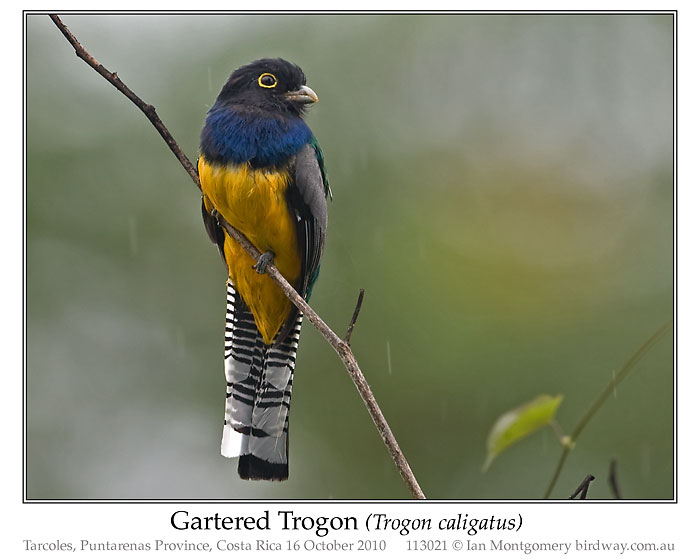
The first family in the non-passerines (non perching birds) with blue and yellow members is the Trogonidae which includes both the Trogons and Quetzals. There are about five closely related South American Trogons, all members of the genus Trogon, that are mainly blue and yellow. These five were originally two species but have been split, so the Gartered Trogon, first photo, was formerly a race of the Violaceous Trogon. Trogons are among my favourite birds and come in a wonderful variety of colours: Birdway: Trogonidae.
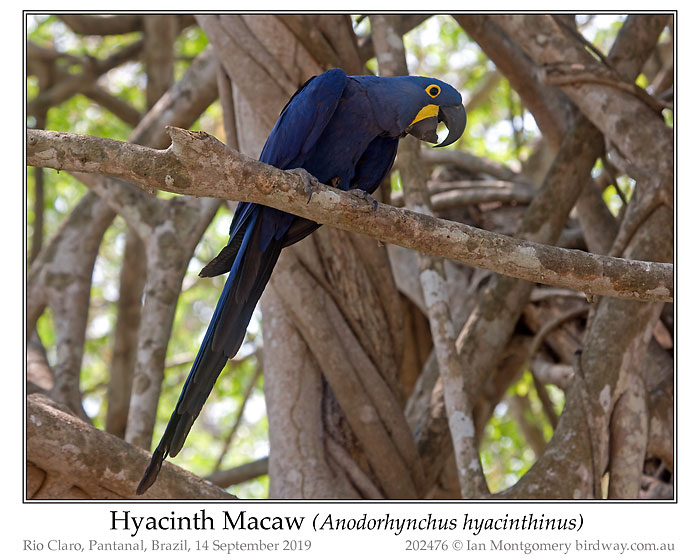
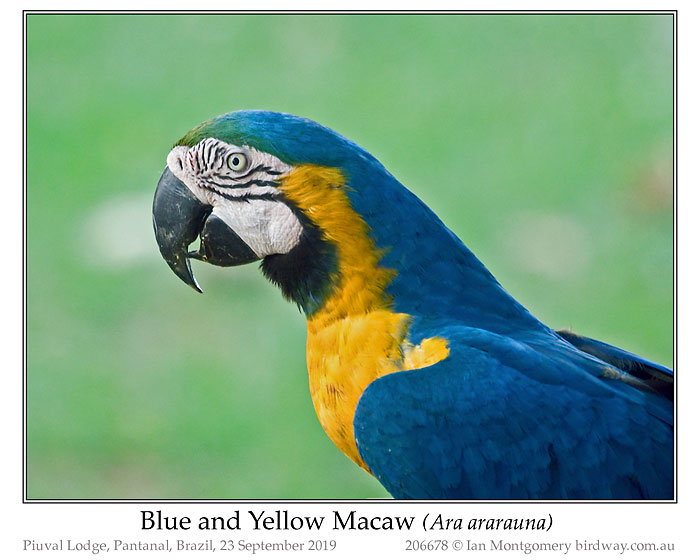
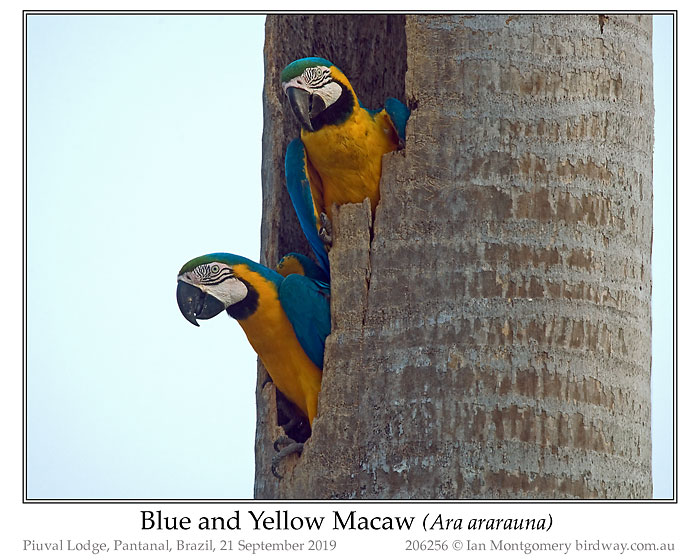
Parrots are the next taxon to have blue and yellow birds. Perhaps the most outstanding blue and yellow parrot is the Hyacinth Macaw, second photo. That was one of the must-see species on the trip to the Pantanal in central Brazil in 2019 with my pal Trish, and it lived up to expectations. We also saw the Blue and Yellow Macaw, third and fourth photos, and it is forgiven for having a bit of black and white and greenish eyebrows. This particular pair resided in the remains of a palm tree beside the pool at one of the lodges. The landscape around the pool had life-size plaster statues of various birds and, while in the pool, I had dismissed the Macaws as just mere ornaments until one of them moved.
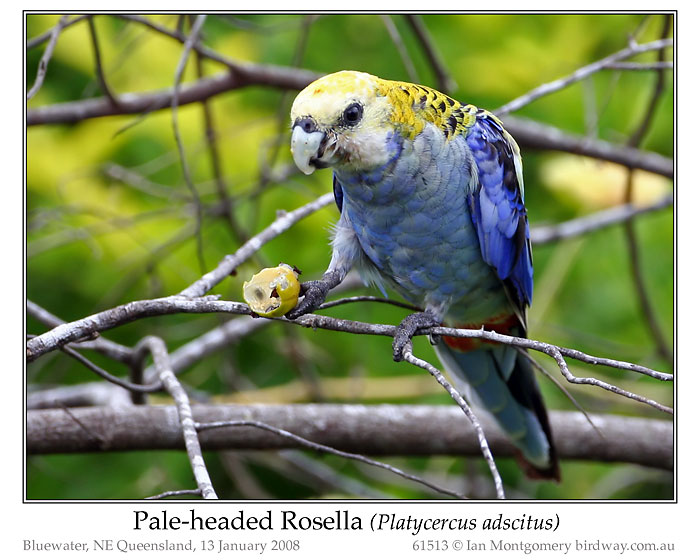
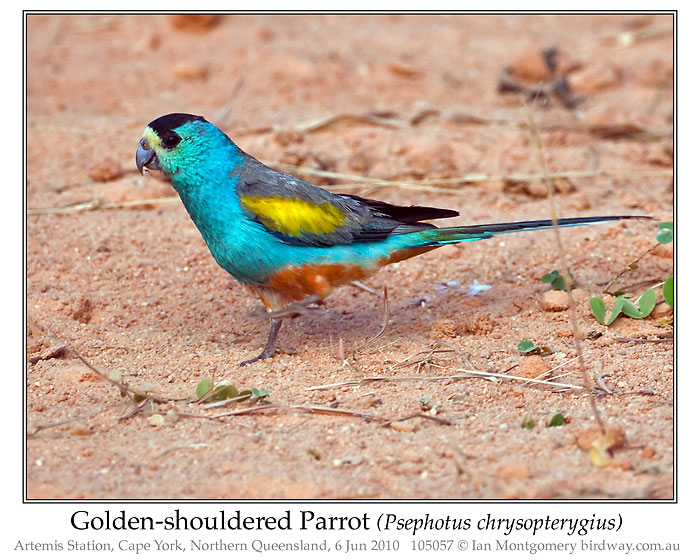
Of the Australian parrots, the Pale-headed Rosella is the best candidate for blue and yellow, fifth photo, but you have to ignore the red undertail coverts (parrots can't resist being over the top). Having given it a bit of leeway, it would be arbitrary not to include the Golden-shouldered Parrot, below, and mention its similar relative the Hooded Parrot Birdway: Hooded Parrot.
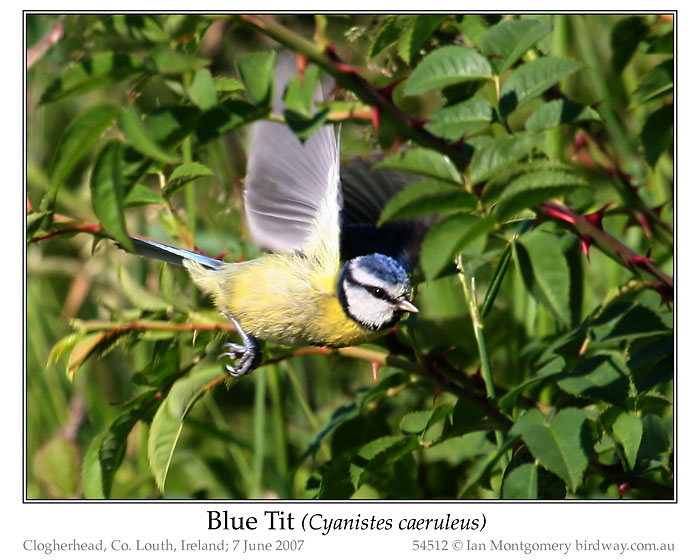
I couldn't find any other non-passerine families with predominantly blue and yellow plumage. There are plenty with blue feathers, such as Kingfishers, but they seem to be satisfied with that and don't bother with yellow. The ones I did find were almost all tropical but when I navigated through the taxonomic tree of the passerines, the first species encountered was the decidedly temperate Blue Tit.
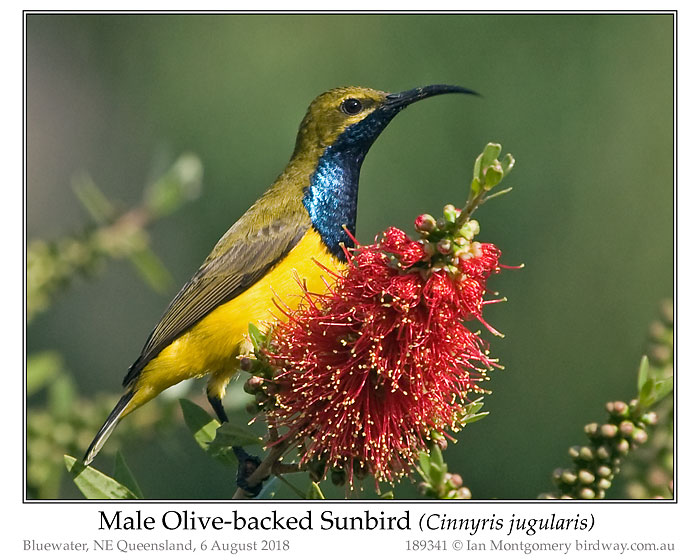
Among Australian passerines, the only qualifying species that I could find was the Olive-backed Sunbird, which, in appearance and behaviour at least, is the closest one can find to Hummingbirds outside the Americas.
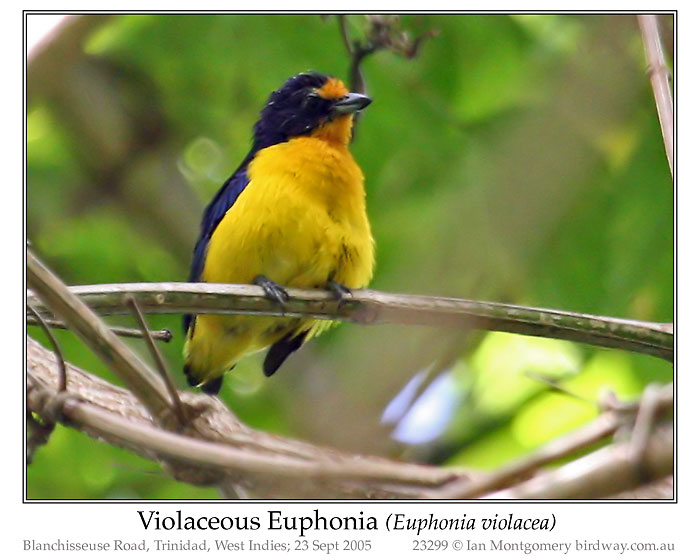
The Euphonias, members of the Finch family, Fringillidae, comprise a genus of about 25 species in the Americas from Mexico southwards. About twenty of these are rather similar yellow and blue birds - allowing for iridescent variability. As well as qualifying for inclusion here, they are melodious - Euphonia means "fine-voiced" in Greek.
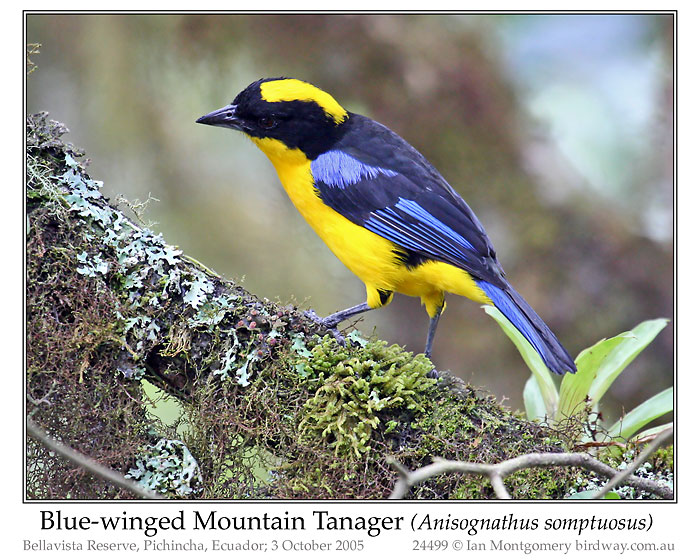
Last but not least, we come to the final family in the tree, the American Traupidae, a very heterogeneous collection of colourful birds. The one that matches our criteria best is the gorgeous Blue-winged Mountain Tanager, a common bird in the cloud forests of the Andes.
Of all the birds in this blue and yellow collection, this is the only one in which the blue and yellow female is visible when nesting, as the sexes are identical and the nest is cup-shaped. In all the others, the nest is globular (Sunbird, Euphonia) or in a tree hollow, wall or other enclosed space (Macaws, Rosellas, Tits) or in a termite mound (Golden-shouldered Parrot) or bee or wasp nest (Trogons). Furthermore, in some species only the male is brightly coloured and the female is more subdued (Trogon, Golden-shouldered Parrot, Euphonia). Little information is available about the nesting habits of Mountain Tanagers. Maybe, they're good at hiding them in the epiphytes characteristic of cloud forests or perhaps they don't need camouflage in the misty gloom.
Finally, I'll let you guess which country I'm making a political statement about. There are four with exclusively blue and yellow flags: Kazakhstan 🇰🇿, Palau 🇵🇼 , Sweden 🇸🇪, and Ukraine 🇺🇦. Kazakhstan, quite incidentally, has a yellow Steppe Eagle on its flag:
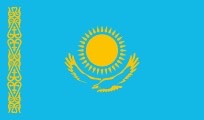
Maybe it’s worth a birding visit but I’m getting off the point. The eagle does, however, represent freedom, power and the flight to the future, all very relevant.
Greetings
Ian
Join the The Irregular Bird Club
Birdway has a free Irregular Bird - formerly Bird of the Moment/Week - Club, enjoyed around the world since 2002 by currently 1000 members. An illustrated article is sent to club members at intervals. The photos are significantly better quality images than those on this web page which are compressed more for faster loading.

The club is a Google Group called Birdway to which only Ian can post. To join the group, enter your email address in the Google box below and click the Join button. This will take you to the Google Group joining page for confirmation. Alternatively, email Ian directly using the Contact link below and he'll gladly do it for you and answer any questions.
Ian also uses the Irregular Bird to keep club members up to date with developments, such as improvements to the website and publication of ebooks. He will not reveal your email address to anyone else nor use it for any other purpose.
Page revised on 16 April 2026