 Hide
Hide




The last Irregular Bird was a political one based on colour - Blue and Yellow. Here's another political colour, Teal, a mixture of blue and green. It's political because we've just had a federal election in Australia, in which the most notable feature was the success of the Teal candidates, a new phenomenon in Oz politics.
The Labor party (Red) won government with a slender majority, replacing the Liberal-National party coalition (Blue), but it did so only on preferences. Noteworthy was the success of the Teal candidates, a group of mainly female independent candidates who challenged incumbent Liberal members in supposedly safe affluent urban seats on a platform of climate action, political integrity and gender equality.
Most of them used the colour teal as branding to represent the mixture of Blue and Green politics. About seven (depending on who you count as Teal) won seats in Sydney, Melbourne and Perth. Meanwhile, the Greens were very successful in similar seats in Brisbane, increasing their number of federal MPs from one to four and holding the balance of power in the senate with 12 of the 76 seats.
Anyway, back to colours and birds. Teal, as a colour, is named after the blue-green crescent-shaped patch on the head of the male Teal, the smallest duck, and first used to describe a colour in 1917. Originally called the Common Teal (Anas crecca), it is now usually split into two species, the Eurasian Teal (Anas crecca) and the Green-winged Teal (Anas carolinensis) of America. The differences in appearance are fairly slight. The male Green-winged has a vertical white stripe behind the breast and an incomplete buff stripe lining the green patch on the head (first photo). The male Eurasian has a horizontal white stripe along the side of the body and lacks the vertical white stripe.
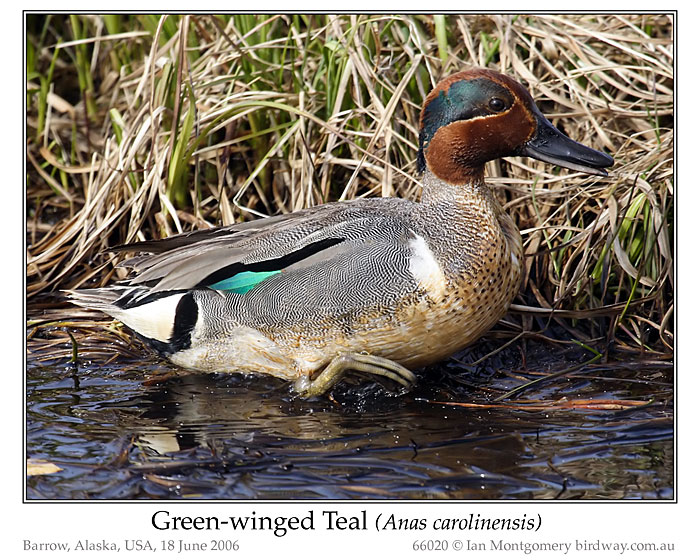
The Green-winged Teal breeds in a broad band across North America, mainly north of about 40ºN. It winters mainly in the United States, Mexico and the Caribbean. The Eurasian Teal breeds across Eurasia from Iceland to Siberia mainly north of about 45ºN.Its winter range includes Western and Southern Europe, the Middle East, South and South-east Asia, and parts of Africa north of the Equator. There have been several records of Eurasian Teal in Australia, mainly in the Cocos Keeling Islands with records at a couple of mainland sites in the Pilbara region of Western Australia in 2019.
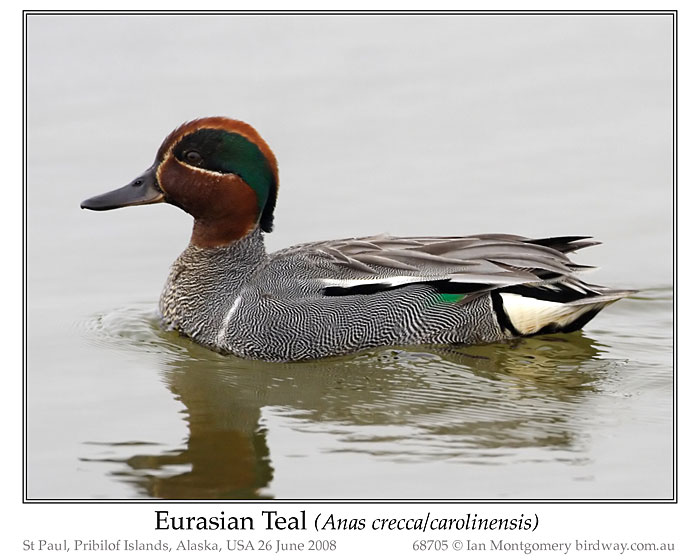
The second photo was taken in the Pribilof Islands in the Bering Sea, half way between Eurasia and North America and the bird has both white stripes. The population there is usually considered to be Eurasian Teal, but this individual looks like a hybrid to me. Ducks are notoriously carefree about interspecific breeding, so hybrids are common, making it unwise to be too prescriptive about the boundaries between species of ducks.
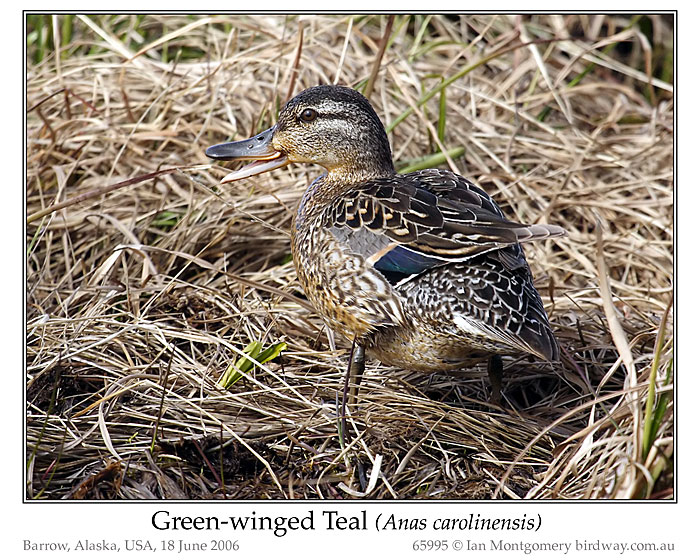
Females, juveniles and non-breeding ('eclipse') males are streaked brown all over like the female in the third photo and look similar in both species. The head markings on these birds are somewhat darker in Green-winged than in Eurasian birds and the pale band in front of the greenish speculum on the wing is darker and more rusty in the Green-winged, as in this one. She was the partner of the male in the first photo.
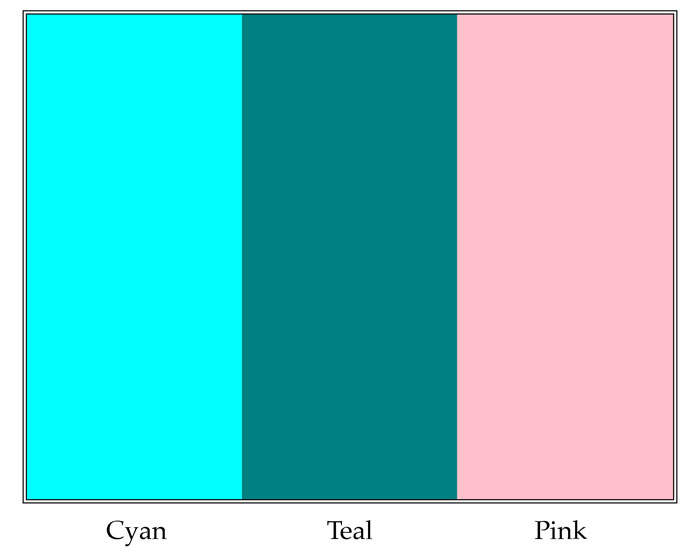
Teal is an official colour these days, with specific definitions for computer based systems such as RGB (Red, Green, Blue) and CMYK (Cyan, Magenta, Yellow, Black). In RGB, Teal is shown in the centre of the fourth image, and it's just a darker version of Cyan. The complimentary colour to Teal is Pink, a combination that was very popular in the eighties. There is now a Teal Blue and a Teal Green, but I don't think we'll go there. In New Zealand, Teal is likely to conjure up memories of TEAL, Tasman Empire Air Lines, the forerunner of Air New Zealand, which used this colour in its branding and accessories.
Meanwhile, we wait with baited breath for more conservation- and climate-friendly policies from the new Australian Government. The previous prime minister's most enduring image for me, and I suspect many others, will be him brandishing a lump of coal in the Federal Parliament
Greetings
Ian
Join the The Irregular Bird Club
Birdway has a free Irregular Bird - formerly Bird of the Moment/Week - Club, enjoyed around the world since 2002 by currently 1000 members. An illustrated article is sent to club members at intervals. The photos are significantly better quality images than those on this web page which are compressed more for faster loading.

The club is a Google Group called Birdway to which only Ian can post. To join the group, enter your email address in the Google box below and click the Join button. This will take you to the Google Group joining page for confirmation. Alternatively, email Ian directly using the Contact link below and he'll gladly do it for you and answer any questions.
Ian also uses the Irregular Bird to keep club members up to date with developments, such as improvements to the website and publication of ebooks. He will not reveal your email address to anyone else nor use it for any other purpose.
Page revised on 17 April 2026