 Hide
Hide




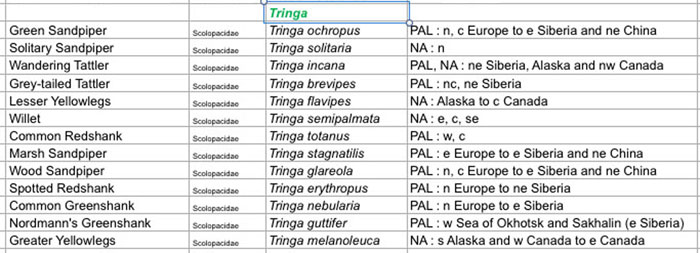
The next two birds in the IOC list of Tringas are the two Tattlers, the Wandering and the Grey-tailed, so called one assumes because they are fairly vocal.
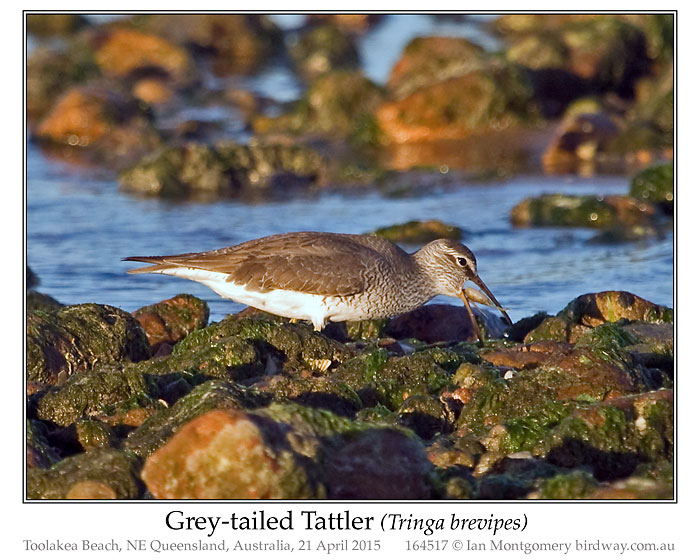
This week’s birds are for those who appreciated subtlety, or at least acknowledge the challenge in identifying waders. The Wandering Tattler (Tringa incana) in non-breeding plumage is very similar to its much commoner (in Australia) cousin the Grey-tailed Tattler (Tringa brevipes). I’ve put numbers on the image of the Grey-tailed Tattler to highlight the differences:
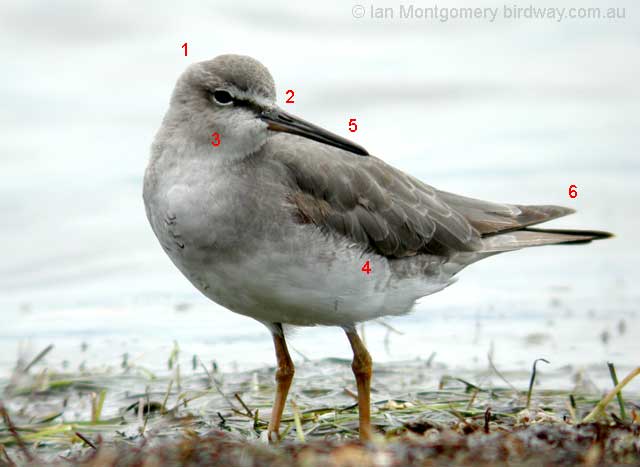
In the Grey-tailed Tattler, the white eyebrow extends behind the eye (1) and forward across the forehead (2); the cheek is whiter (3); the flanks are whiter (4); the bill is longer and more slender (5) and the wing tips, relative to the tail, are shorter (6). The Wandering Tattler is darker overall and particularly on the back and crown and to me looked browner rather than grey-brown. If you think this is all too hard, the calls come to the rescue, being quite different. The Wandering has a trilling call of 6 – 10 accelerating notes, while the Grey-tailed has a drawn out 2 syllable call.
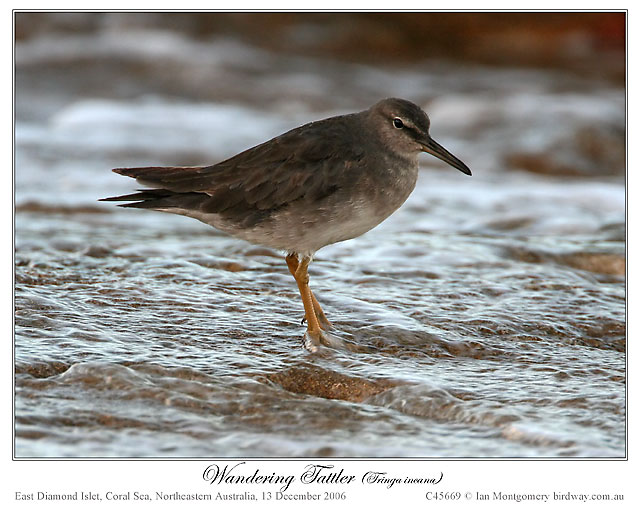
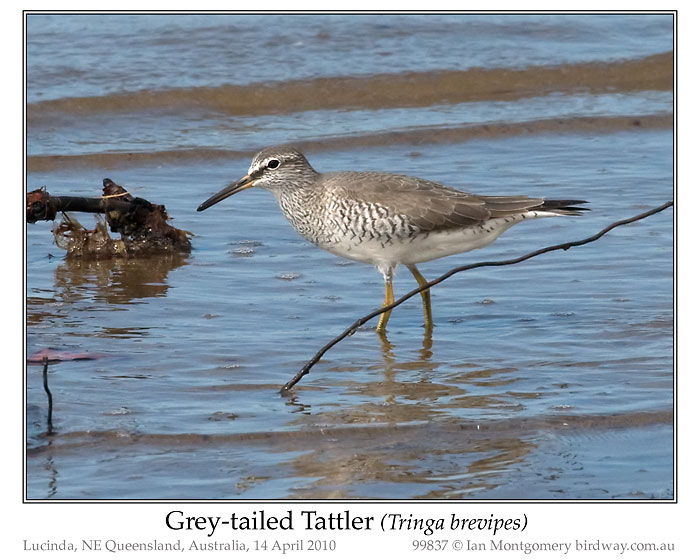
The Grey-tailed Tattler is a (southern) summer migrant on the coast all round Australia on mudflats and reefs, while the Wandering is an uncommon summer visitor to the east and north coasts, with a preference for wave-washed rocks on the island of the Great Barrier Reef.
It's easier to distinguish the two species when in breeding plumage. Both are barred on the breast and flanks, but only the Wandering has barring on the belly. The Grey-tailed retains the white belly even in breeding plumage. The one below in the third photo is feeding in a typical habitat in shallow water on a mudflat
Here's another Grey-tailed in breeding plumage swallowing a small crab at sunset. This might look more like the habitat of the Wandering Tattler, but it's actually a stony area on a beach rather than a rocky headland.
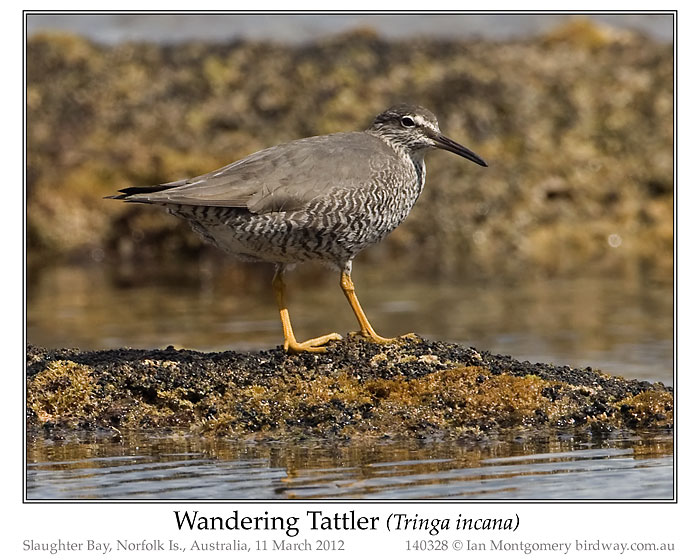
This Wandering Tattler, below, is feeding in a typical habitat for this species, on a rocky foreshore with plenty of invertebrate prey on a Pacific Island. The tourist literature about Norfolk Island says that the name Slaughter Bay isn't as ominous as it sounds, being derived from an "Old English word" meaning "slow-moving water". Given that strong currents are reported in Slaughter Bay, that I could find no aquatic suggestions for "Slaughter" in dictionaries or online, and that Norfolk Island has a turbulent history as a convict settlement, I suspect that this is an explanation of which the Kremlin could be proud.
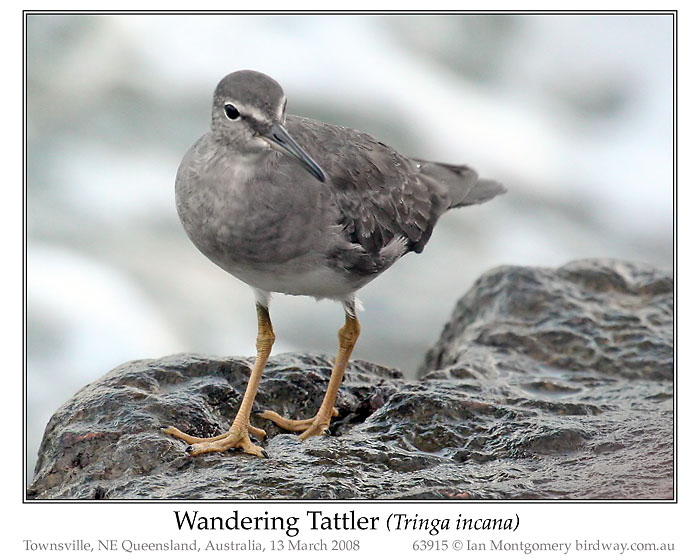
Wandering Tattlers in Australia are most likely to be seen on rocky islands, but they do turn up occasionally on the mainland as well, with records all on the east coast from Cape York to eastern Victoria. The one below was one of a pair that spent some time on the Townsville Breakwater in 2008 and there are more recent records there in 2010 and 2022. This photo clearly shows the grey patch on the forehead between the two short white eye-stripes.
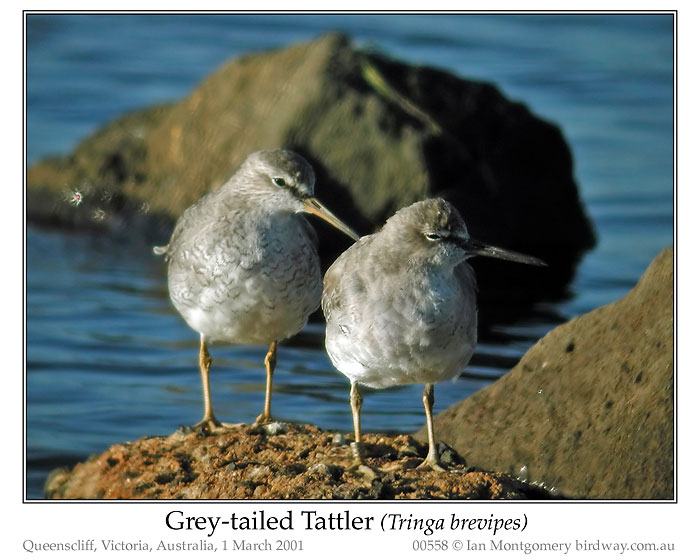
The Grey-tailed Tattlers in this photo are also perched on rocks and pretending they're Wandering Tattlers. In fact they are waiting for the tide to go out so they can feed on the neighbouring mudflats. The one on the left is in transitional plumage with barring developing on the breast.
Both species are accomplished migrants, breeding in northern latitudes and spending the northern winter in the tropics and southern hemisphere. The Grey-tailed Tattler breeds in inland northeastern Siberia and western Siberia and winters across a wide range from the Bay of Bengal and Taiwan through southeastern Asia to Australia and New Zealand. The Wandering breeds in Alaska and in neighbouring parts of Canada south to northwestern British Columbia. It winters all along the west coast of the Americas from southwestern British Columbia to Chile and across Pacific coast and islands from Japan to New Zealand, through Micronesia, Polynesia to Pitcairn Island and Easter Island.
In terms of conservation, the Wandering Tattler has a status of Least Concern, while the Grey-tailed has been uplisted from Least Concern to Near Threatened in 2014. This reflects some decline in numbers, probably as a result of land reclamation along the migratory stopovers in China.
Greetings
Ian
Join the The Irregular Bird Club
Birdway has a free Irregular Bird - formerly Bird of the Moment/Week - Club, enjoyed around the world since 2002 by currently 1000 members. An illustrated article is sent to club members at intervals. The photos are significantly better quality images than those on this web page which are compressed more for faster loading.

The club is a Google Group called Birdway to which only Ian can post. To join the group, enter your email address in the Google box below and click the Join button. This will take you to the Google Group joining page for confirmation. Alternatively, email Ian directly using the Contact link below and he'll gladly do it for you and answer any questions.
Ian also uses the Irregular Bird to keep club members up to date with developments, such as improvements to the website and publication of ebooks. He will not reveal your email address to anyone else nor use it for any other purpose.
Page revised on 11 April 2026