 Hide
Hide




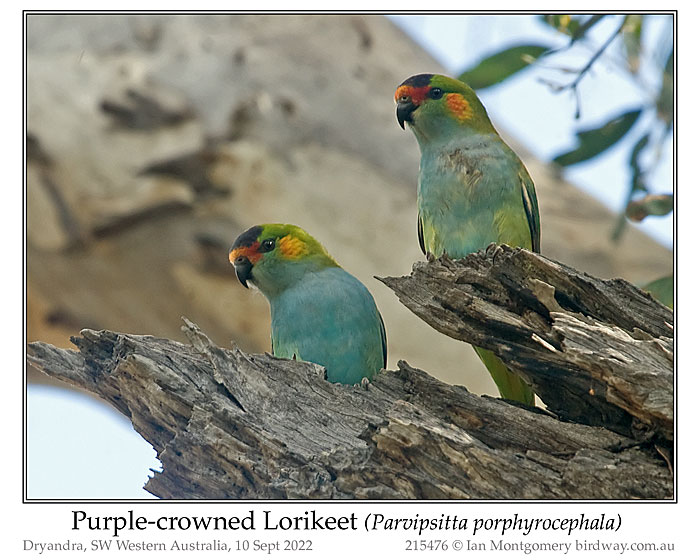
As promised in my season's greeting post, here is an Irregular Bird after a long silence on my part, the Purple-crowned Lorikeet. It's widespread and fairly common along coastal southern and south-western Australia from about Melbourne to Perth and inland to Albury, Mildura, Port Augusta and Kalgoorlie. This isn't an area I've spent much time in since I moved to Townsville in 2002, so until 2022 my observations of this species were limited to distant views of it feeding high up in flowering Eucalypts.
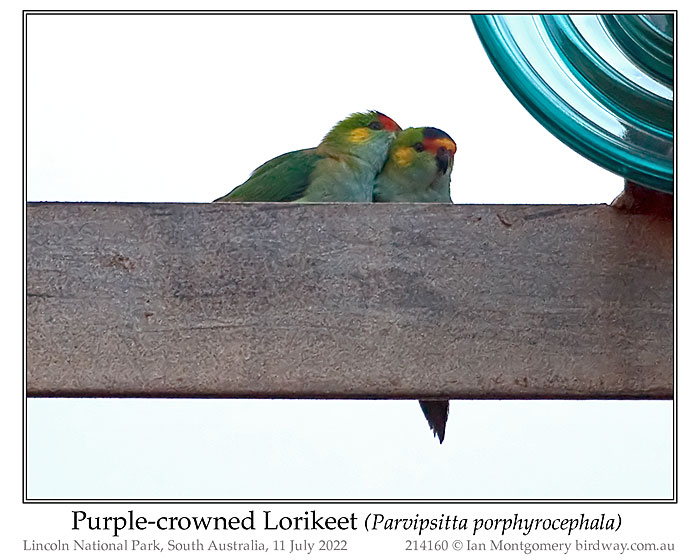
In July 2022, I went on a road trip from Melbourne to Mount Isa via Port Lincoln in South Australia and the Birdsville Track with Joy, a birding friend from Melbourne, and a couple of English birders. In Lincoln National Park at the tip of the Eyre Peninsula, we came across this pair of Purple-crowned Lorikeets. An amorous male was making up to a coy female (I presume: the sexes are identical in appearance) with little success. The cross-arm of an electric power line wasn't ideal for nature photography but it was my first opportunity to photograph them in the open.
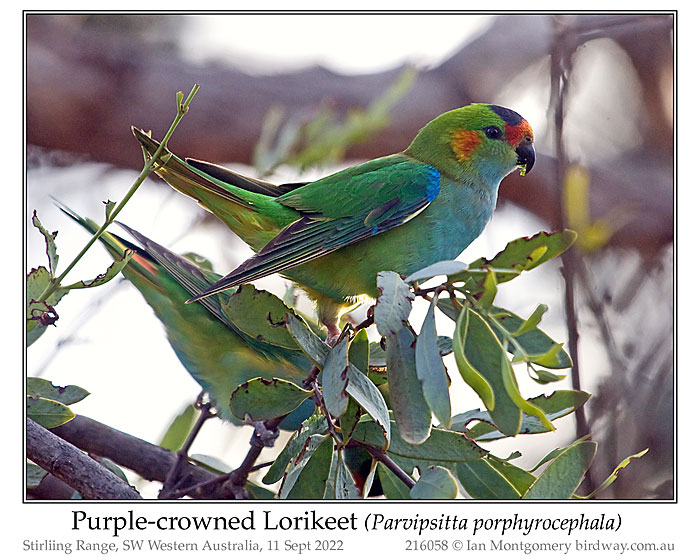
I had more success with natural surroundings and close views on a trip to Western Australia later in the same year with Trish, a friend from Townsville. These ones were in the Stirling Range, an area of striking-looking mountains rising dramatically out of an otherwise flat countryside and a place that I had long wanted to visit. Close up, one can see how beautiful these tiny Lorikeets are.
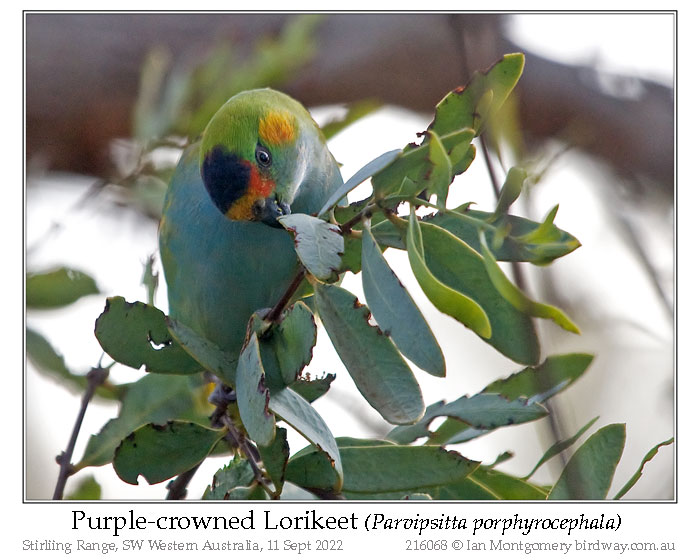
These Lorikeets are supposed to feed mainly on nectar, pollen and sometimes fruit, but these ones look as if they are nibbling on gum leaves or maybe on lerps on the leaves. Lerps incidentally are sugary secretions produced as a protective covering by lerp insects and are a popular food of both birds and mammals.
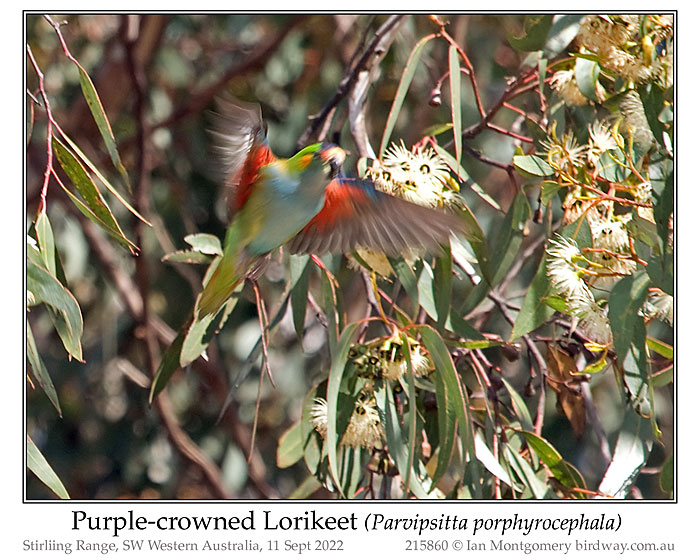
With a length of only 15-17cm (6-7in), the Purple-crowned Lorikeet is indeed tiny and similar in size to the Little Lorikeet (15-16.5cm). The only Australian parrot that is smaller than these is the Double-eyed Fig Parrot (13-16cm) which is about the same weight (35-55g) but has a shorter tail. If you want to identify small Lorikeets feeding high in gum trees, the Purple-crowned is the only small Australian parrot species with red underwings, a very useful field guide as in this photo.
Dryandra Woodland National Park, about one third of the way between Perth and Albany on the south coast, was another location in Western Australia where we came across cooperative Purple-crowned Lorikeets. Being Spring, we wondered whether this pair was searching for a nesting hollow.
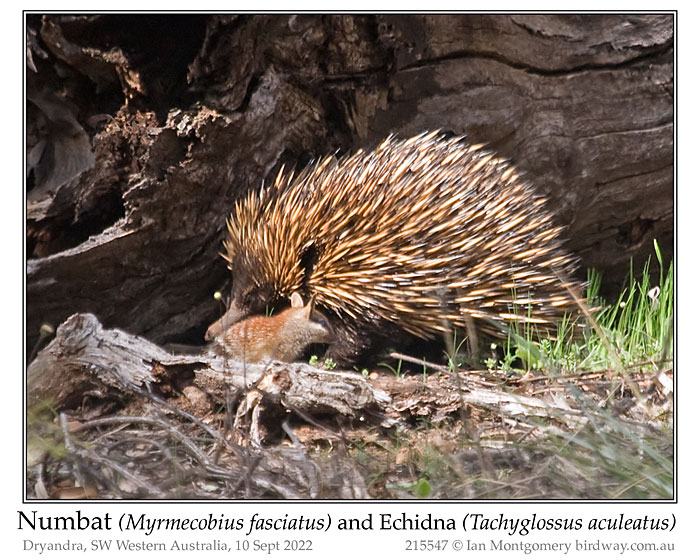
Dryandra is a well-known spot for interesting woodland birds, it is also one of perhaps two locations where the Numbat, a critically endangered marsupial, survives naturally. So you can imagine our delight when we found this young one feeding with an Echidna. Both species feed mainly on termites, and the Numbat was picking up ones dug up by the Echidna, which was excavating the rotten timber below a fallen tree.
A little later the Numbat wandered off and nonchalantly walked right past me, the sort of photo opportunity one can only dream about. Once upon a time, the Numbat ranged widely across southern Australia, before habitat destruction and feral predators brought it close to extinction. Happily, serious efforts are being made to protect the remaining populations and the Australian Wildlife Conservancy has reintroduced it to two predator-free reserves in NSW.
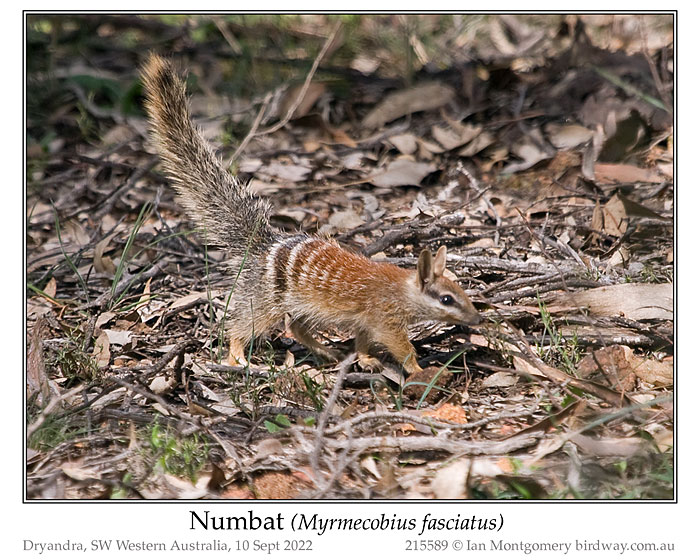
If the stripes on the back of the Numbat remind you of photos of the extinct Thylacine (Tasmanian Tiger), it won't come as a surprise to learn that recent DNA studies indicate that the Numbat and the Thylacine may be related and have been placed in sister families in the same branch of the order of faunivorous marsupials.
I send you best wishes for the New Year
Ian
Join the The Irregular Bird Club
Birdway has a free Irregular Bird - formerly Bird of the Moment/Week - Club, enjoyed around the world since 2002 by currently 1000 members. An illustrated article is sent to club members at intervals. The photos are significantly better quality images than those on this web page which are compressed more for faster loading.

The club is a Google Group called Birdway to which only Ian can post. To join the group, enter your email address in the Google box below and click the Join button. This will take you to the Google Group joining page for confirmation. Alternatively, email Ian directly using the Contact link below and he'll gladly do it for you and answer any questions.
Ian also uses the Irregular Bird to keep club members up to date with developments, such as improvements to the website and publication of ebooks. He will not reveal your email address to anyone else nor use it for any other purpose.
Page revised on 18 April 2026